By Cubby McMenamy
Florida's hurricane season runs June 1 through November 30 so exterior inspections should happen at least twice a year, ideally before and after that window
Roofs, windows, and doors are the building envelope components most vulnerable to wind and water intrusion during storms, according to FEMA's building performance research
The 2023 Florida Building Code (8th Edition), effective December 31, 2023, sets updated standards for underlayment, impact-rated glazing, and wind resistance that directly affect your home's compliance and resilience
Always hire a Florida state-licensed contractor because roofing work requires a license issued by the Florida Construction Industry Licensing Board (CILB), and the same applies to window and door installation
A qualified contractor should carry both workers' compensation and contractor liability insurance; always ask for proof before any work begins
Catching small problems early can save thousands; a minor roof repair costs a fraction of what major water damage costs after it's had time to spread
Your home's exterior is the only barrier standing between your family and Florida's most brutal weather. Here in the Sunshine State, that barrier gets tested hard. The relentless UV rays of a central Florida summer. The salt air rolling off Tampa Bay. The afternoon thunderstorms that soak Palm Harbor from June through October. And the threat, always present, of a named storm that can reshape a neighborhood in hours.

Having Trouble with Your Home's Exterior?
Upgrade your doors, windows, or roof with confidence! Get a personalized quote today and see how easy it is to transform your home.
Call for ConsultationMost homeowners think about maintenance after something goes wrong. A roof leak. A door that won't seal properly. A window that lets in wind-driven rain during a storm. But the smartest Florida homeowners treat exterior maintenance like an investment because that's exactly what it is.
We've built a checklist specifically for Florida homes that zeroes in on the three exterior components that matter most: your roof, windows, and doors. These are the elements that, when neglected, open the door (literally) to catastrophic damage. They're also the elements where proactive care delivers the biggest return.
Why Florida's Different: Climate Reality for Homeowners
It may sound obvious to say that Florida isn't like everywhere else. But the implications for your home's exterior are significant and easy to underestimate.
The combination of extreme heat, near-constant humidity, exposure to intense ultraviolet (UV) radiation, and seasonal hurricane risk creates a maintenance environment that accelerates wear on every component of your home's shell. What might be a 20-year material in Ohio tends to function like a 12-to-15-year material in Tampa or Orlando.
High humidity, hurricanes, and scorching temperatures create specific challenges that Florida homeowners face unlike those in most other states. For homeowners in Orlando, Tampa, Winter Park, and Palm Harbor, this means that your exterior maintenance schedule needs to be more frequent and thorough than a generic national checklist would suggest.
Your Roof, Florida's First and Most Critical Line of Defense
If you had to choose just one exterior system to keep in perfect condition in Florida, it would be your roof. No other exterior component takes more physical abuse or causes more cascading damage when it fails.
Roof systems, including roof coverings of all types, fail at concerning rates during hurricane events, even when wind speeds fall within code expectations, according to the Federal Emergency Management Agency (FEMA)'s analysis of building performance after major storms. You may be surprised to learn that even a roof that was installed to code can fail if it hasn't been maintained or if small issues have been allowed to compound over time.
Know Your Roof Type Because Maintenance Differs
Florida roofs come in a few main varieties, and each one ages differently in our climate.
- Asphalt shingle roofs—Common across central Florida, including throughout Orlando and Winter Park neighborhoods, asphalt shingles can last around 20 years in our state though they may need to be replaced at 15 years. Signs of trouble include curling, cracking, or missing shingles. (For more details, see our guide on the signs your roof needs replacement in Florida.)
- Tile roofs—Both clay and concrete tile roofs are widespread in the Tampa and Palm Harbor areas. Tile roofs are more durable than shingles and can last around 50 years. However, Florida's conditions often cut that lifespan approximately in half (also see how long a roof lasts in Florida). Also, individual tiles can crack and should be checked regularly.
- Flat or low-slope roofs—These types of roofs require the most vigilance. Check for standing water after significant rain. Ponding water adds structural stress and dramatically accelerates membrane deterioration.
Roof Inspection Checklist for Florida Homeowners
At a minimum, you should inspect your roof twice a year: once before hurricane season begins, ideally in April or May, and once after it ends, in December. After any significant storm, do a visual check from the ground using binoculars before considering climbing up.
What to look for:
- Missing, cracked, lifted, or curling shingles or tiles
- Exposed nail heads or fasteners that have backed out
- Dark staining, moss, or algae growth, especially common in Tampa Bay area homes due to humidity
- Damaged or rusted flashing around chimneys, vents, and skylights
- Soft spots or sagging areas because they signal structural concerns
- Debris accumulation, especially in valleys where water channels
- Condition of ridge caps and hip caps as these are often the first to fail in wind events
- Condition of the drip edge along the eave line
Gutters matter, too. Clogged gutters can lead to water pooling around your home's foundation, increasing the risk of flooding and structural damage. Clear out leaves, twigs, and debris and make sure downspouts direct water away from the foundation.
In Orlando and Winter Park, oak trees and Spanish moss create aggressive gutter-clogging conditions.
What the Florida Building Code Requires for Roofs
The 8th Edition of the Florida Building Code, which took effect at the end of 2023, introduced meaningful updates to roofing standards. The updated code now requires two layers of underlayment for asphalt shingles, metal roof panels or shingles, and several other roofing types. Nail penetration guidelines were also revised to enhance roofing system stability.
These may sound like just technical details for contractors, but they affect whether your roof will hold up during a wind event and whether future repairs will meet code. If your roof was installed before these requirements, it may perform below today's standards even if it appears intact.
When to Call a Professional Roofer
Roof work can be dangerous, and Florida law is clear that roofing work requires a licensed contractor. Florida statutes also require that roofing contractors be licensed through the Florida Construction Industry Licensing Board (CILB), a division of the Department of Business and Professional Regulation (DBPR).
A state-certified roofing contractor has successfully completed a comprehensive examination and must provide proof of both workers' compensation and liability insurance. Certified contractors are allowed to contract anywhere in Florida without meeting additional local competency requirements.
Before hiring anyone for roof work in Tampa, Orlando, Palm Harbor, or Winter Park, ask for their CCC license number and verify it. You can check contractors' license status at DBPR.
Windows: Energy, Safety, and Storm Resistance, All in One Frame
Windows are easy to overlook until they fail, and the failure can be dramatic in Florida. It can happen when wind-driven rain finds a gap around a window frame. Or a seal breaks down, allowing humidity to condense between panes. Or an older, single-pane window offers no meaningful resistance to debris in a storm.
The building envelope, which includes windows, exterior doors, roof coverings, and wall systems, is under increasingly critical focus as structural performance has improved due to stricter building codes. Windows and unprotected glazing are consistently among the five building envelope components that perform most poorly in hurricane events, according to FEMA.
That's not a detail to brush past. Your windows are among your home's most vulnerable spots.
Florida's Window Requirements: Impact Ratings and Wind Zones
Florida's building code sets specific requirements for windows depending on where your home is located. According to the Florida Building Code, all glazed openings in wind-borne debris regions must be impact-resistant or protected by an approved impact-resistant covering such as hurricane shutters. (For the full code picture, see whether impact windows are required in Florida.)
When windows or doors break under pressure during a hurricane, interior air rapidly pressurizes the home, increasing the likelihood of roof uplift and wall collapse. Impact-rated windows provide benefits beyond storm season, with improved energy efficiency through laminated glass, noise dampening, better UV protection, and stronger home security since laminated glass is harder to breach.
For homes in Tampa and Palm Harbor, both of which face significant coastal wind exposure, understanding your specific wind zone is essential. You can see wind zone maps through your county's building department. A licensed contractor can help you determine what your home currently has and what it may need.
Window Inspection Checklist for Florida Homeowners
Work through the following checklist each spring before hurricane season and again in late fall:
- Inspect all window frames for cracks, gaps, or warping; wood frames are especially susceptible to swelling and rot in Florida's humidity (learn about the best window materials for Florida)
- Check the caulking around every window on the exterior; caulk exterior joints around windows and doors as part of regular seasonal maintenance, replacing any that's cracked, peeling, or pulling away from the frame
- Test every operable window to confirm that it opens, closes, and locks properly; locks that don't engage fully compromise both security and storm resistance
- Inspect weatherstripping for compression and integrity; worn weatherstripping allows both air infiltration, raising your energy bills, and water intrusion during wind-driven rain
- Look for fogging or condensation between double-pane glass; this indicates a failed seal and means that the insulating gas has escaped, reducing both energy performance and the window's lifespan
- Examine window screens for tears and ensure that screen frames are properly seated; loose screens become airborne debris in high winds
- Check sliding glass door tracks for debris, corrosion, or misalignment; track corrosion is especially common in the Tampa Bay salt air environment
A Word About Older Single-Pane Windows
If your Palm Harbor or Winter Park home still has its original single-pane windows, it's a real vulnerability. Beyond the energy cost, Florida summers are brutal on cooling bills; single-pane windows offer almost no impact resistance and only a minimal thermal barrier. Upgrading to impact-rated windows is one of the most meaningful exterior improvements a Florida homeowner can make.
Installation of windows and doors is specific to each manufacturer to achieve required performance ratings including design wind pressure ratings and water penetration resistance. Window and door manufacturers are required to provide installation instructions with their product approvals.
This means that installation matters as much as the product itself. A properly rated impact window installed incorrectly may not perform as rated. Always use a licensed, experienced installer.
Doors, Entry Points That Must Hold Under Pressure
Your exterior doors—front entry, back door, French doors, patio doors, sliding glass doors, and garage door—represent every point where wind, water, and debris can breach your home's shell. They're also among the most mechanically complex exterior components, which means that there are more things that can wear out, misalign, or fail.
Once rain enters a home through poorly sealed windows and doors, mildew can develop within days. Wind damages homes by entering through poorly sealed openings, increasing interior pressure and causing uplift forces on the roof. That sequence: breach at a door or window, pressure increase, and roof uplift is one of the most common and destructive failure patterns in Florida storms.
Door Inspection Checklist for Florida Homeowners
Inspect all exterior doors twice a year, and after any significant storm:
For entry and hinged doors:
- Open and close each door fully and observe whether it hangs level; sagging doors can indicate foundation settlement or frame shifting
- Check the gap around the full perimeter of the door when closed; daylight visible anywhere is air and water infiltration waiting to happen
- Inspect all weatherstripping along the sides and top and inspect the door sweep along the bottom; these are the first seals to wear and the most important for keeping water out during heavy rain
- Test the deadbolt and lockset; they should engage smoothly without forcing
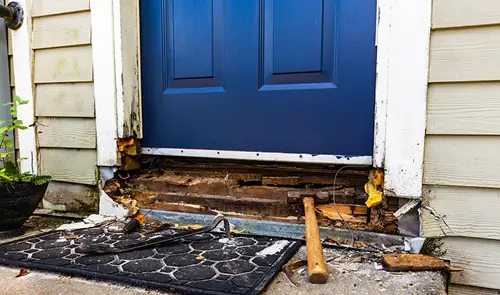
- Examine door frames and thresholds for rot, especially in covered entryways where moisture can collect and go unnoticed (see signs your door frame's rotting for what to look for)
- Check the condition of hinges; hinge corrosion is common in coastal environments like Palm Harbor and Tampa, and stainless steel or coated hardware resists this better
For sliding glass and French doors:
- Clean tracks thoroughly and lubricate with a silicone-based lubricant; avoid petroleum-based products that attract dirt
- Check that the panel lifts smoothly and rolls without catching; a door that doesn't roll freely is straining its hardware and may jump the track in a wind event
- Inspect all glazing for cracks or chips; inspect the seal between the glass and frame
- Test the locking mechanism on every panel including any secondary security bars or pins
For garage doors, a critical and often overlooked component:
- Check the track on your garage door by grabbing each section of track with both hands to see if it is loose or can be twisted; if so, a stronger track should be installed and properly anchored to the wall framing with heavy bolts. In a hurricane, an unsecured garage door is one of the most likely failure points on the entire house.
- Check all springs, cables, and rollers for wear; these components have a finite cycle life
- Test the auto-reverse safety feature by placing a 2x4 flat on the floor in the door's path; the door should reverse automatically on contact
- Inspect all panels for dents, cracks, or corrosion; damaged panels reduce structural integrity
- Ensure that your garage door is rated for Florida's wind loads; if it isn't, discuss bracing or replacement options with a licensed contractor
Impact-Rated Doors in Florida: What the Code Requires
The Florida Building Code's requirements for doors in wind-borne debris regions mirror those for windows. Florida homeowners often pair impact windows with storm-resistant exterior doors such as hurricane doors or impact doors.
While shutters and removable storm panels can meet code requirements, they provide protection only when installed correctly before a storm. Shutters require action before a storm arrives.
They can't protect you if you're traveling, if a storm develops quickly, or if you simply can't install them in time. Permanently rated impact doors and windows provide around-the-clock protection without requiring any prestorm intervention.
Seasonal Timing: Building Your Florida-Specific Maintenance Calendar
Generic home maintenance guides often use seasons that don't map well onto Florida's actual climate. Our framework, however, reflects how weather actually moves through the central Florida region including Orlando, Tampa, Winter Park, and Palm Harbor.
Spring (March - May): Preseason Preparation
This is your most important window for exterior work. The weather is cooperative, contractors are available, and hurricane season is close enough to create urgency.
- Complete your full roof inspection or schedule a professional inspection
- Inspect all windows and recaulk anywhere the seal has degraded
- Check all exterior door weatherstripping and thresholds
- Clean and test garage door mechanisms
- Clear gutters and downspouts completely
- Trim trees and branches that overhang or touch the roof, windows, or doors; falling limbs are one of the most common sources of storm damage in Orlando and Winter Park neighborhoods that have mature tree canopy
Early Summer (June – July): Hurricane Season Begins
- Verify that impact shutters are accessible and in working condition (if your home relies on them)
- Confirm that all exterior doors lock securely
- Do a final visual roof check from the ground
- Make sure you have the contact information for your licensed roofing, window, and door contractor readily accessible
Poststorm (Any Time): Immediate Assessment
After any storm, wind event, or hail:
- Inspect your roof from the ground with binoculars before anyone walks on it
- Check all windows for cracked glazing, damaged seals, or frame damage
- Examine all exterior door frames for racking or warping
- Look for water stains inside the home near windows, doors, and ceilings; these reveal intrusion that may not be obvious from outside
- Document everything with photos before making temporary repairs
If damage is significant, our guide to filing a roof insurance claim in Florida lists the deadlines and explains the deductibles that tend to trip homeowners up.
Fall (November – December): Postseason Review
- Complete a full exterior inspection now that hurricane season has ended
- Address any damage or deferred maintenance before winter brings cooler, drier conditions that are ideal for exterior work
- Recaulk any window or door seams that weathered the season
(For a fuller seasonal checklist, see our guide to winterizing Florida homes.)
How to Hire the Right Contractor in Florida
We have many contractors in Florida and, after storms, it can attract people who shouldn't be trusted with your home. This matters whether you're in Winter Park looking for a window upgrade or in Palm Harbor dealing with storm damage.
Before signing anything, be sure to ask the following nonnegotiable questions:
- Are you state-licensed?
For roofing, look for a CCC or RC license number and verify it. For windows and doors, verify licensing with the Florida DBPR. - Do you carry workers' comp and contractor liability insurance?
Ask to see copies of certificates of insurance for both workers' comp and contractor liability before any work begins. Without this information, you may be liable if a worker is injured on your property. - Will you pull the required permits?
Any significant roof, window, or door work in Florida requires permits. A contractor who suggests skipping permits is a contractor who'll leave you with unpermitted work that can complicate future sales or claims. - Do you provide a written quote or proposal and warranty?
Get everything in writing: scope of work, materials, timeline, and warranty terms. - Do you have references from Florida homeowners?
A reputable contractor should be able to provide client references for you to contact.
Authoritative Information Sources:
- Federal Emergency Management Agency (FEMA): Reducing Water Intrusion Through Windows and Doors (Recovery Advisory 3)
- Federal Emergency Management Agency (FEMA): Summary Report on Building Performance: 2004 Hurricane Season (FEMA 490)
- Florida Division of Emergency Management / Florida's Foundation: Make Mitigation Happen
https://www.floridadisaster.org/globalassets/importedpdfs/wind-mitigation-booklet-.pdf - Florida Roofing and Sheet Metal Contractors Association, Inc. (FRSA): For Consumers: Replacing Your Roof
- Florida Department of Business & Professional Regulation (DBPR): Florida Building Commission: Florida Building Codes
- Florida Department of Business & Professional Regulation (DBPR): Florida License Verification
Your Home Can Handle Florida Weather If… You Help It
Florida homes are built to endure a challenging climate. But they can't maintain themselves.
The roof over your head, the windows filtering your light, and the doors keeping your family safe require your attention, a consistent schedule, and qualified professionals who know Florida's code and climate.
Homeowners in Orlando, Tampa, Winter Park, and Palm Harbor all share the same exposure. And they all share the same opportunity: catch small things before they become expensive things.
A cracked caulk line around a window is a five-minute fix today or a moldy wall six months from now. A lifted roof shingle is a quick repair now or a major interior water damage claim after the next afternoon storm. A door sweep that's lost its seal is a minor replacement today or a flooded threshold in the next heavy rain.
The exterior home maintenance checklist in Florida is about consistency. Show up twice a year with a clear eye and a good checklist, work with licensed professionals when the job calls for it, and your home will do its job protecting everything inside it.
Looking for a licensed contractor serving Orlando, Tampa, Winter Park, or Palm Harbor for roof, window, or door work? Our team specializes exclusively in roof replacement and repair, window installation, and door replacement, which means that we accomplish every project with a deep level of expertise and top quality.
Schedule your home's exterior evaluation before storm season arrives, and our team will comes to your home, inspect your roof, windows, and doors, and give you a written assessment with no obligation.
Having Trouble with Your Home's Exterior?
Upgrade your doors, windows, or roof with confidence! Get a personalized quote today and see how easy it is to transform your home.
Call for Consultation